From now on, we'll be broadcasting from our new home, obscenedesserts.eu.
Change your dials as appropriate!
Sunday, February 18, 2018

Saturday, July 01, 2017


Monday, June 05, 2017

Monday, April 03, 2017



Tuesday, March 28, 2017
Useful distinctions
In the course of writing the conclusion for my current project on Christian intellectuals in Britain in the 1930s and 1940s, I've run across a couple of useful and interesting texts.
One is Duncan Bell's extraordinarily enlightening and relatively recent article "What is Liberalism?", which appeared a few years ago in Political Theory. (The published version is here; a free download of a final draft for those without institutional library access is here.)
The short answer is, of course, "it's complicated". The longer answer is...well, you'll have to read it, as I don't have time to go into it.
However, briefly, it points to the remarkable historical variability of that term, but it also identifies a key shift in the mid-20th century, when "liberalism" came to be defined as the opposite of "totalitarianism". This gave it a broad definition and a (questionably) long and clear political pedigree (John Locke, you might be surprised to find, was only fully recognised as a liberal in the 20th century). And, of course, via the Cold War it became linked it to all sorts of questionable power politics.
Anyway, it's an excellent read -- if political theory were always this clearly written and jargon-free, I'd read a lot more of it -- and very enlightening for anyone interested in the history of this much-used, often-mythologised, and sometimes unfairly maligned term.
But, spoiler alert: you won't find a single, all-purpose definition to throw around at your next cocktail party. Sorry, them's the breaks.
In further researching some things I found in Bell's article, I ran across Ernest Gellner's review of a book on the other term in that pair noted above: "totalitarianism". (Both "liberalism" and "totalitarianism" were commonly used terms in the group I've been researching, but both were used in a particular way that both shared in and departed from their broader usage. Hence my interest.)
Anyway, Gellner raises the question of whether "totalitarianism" and "civil society" are useful terms. He thinks that they are.
Which also, to me, marks some useful distinctions.
One is Duncan Bell's extraordinarily enlightening and relatively recent article "What is Liberalism?", which appeared a few years ago in Political Theory. (The published version is here; a free download of a final draft for those without institutional library access is here.)
The short answer is, of course, "it's complicated". The longer answer is...well, you'll have to read it, as I don't have time to go into it.
However, briefly, it points to the remarkable historical variability of that term, but it also identifies a key shift in the mid-20th century, when "liberalism" came to be defined as the opposite of "totalitarianism". This gave it a broad definition and a (questionably) long and clear political pedigree (John Locke, you might be surprised to find, was only fully recognised as a liberal in the 20th century). And, of course, via the Cold War it became linked it to all sorts of questionable power politics.
Anyway, it's an excellent read -- if political theory were always this clearly written and jargon-free, I'd read a lot more of it -- and very enlightening for anyone interested in the history of this much-used, often-mythologised, and sometimes unfairly maligned term.
But, spoiler alert: you won't find a single, all-purpose definition to throw around at your next cocktail party. Sorry, them's the breaks.
In further researching some things I found in Bell's article, I ran across Ernest Gellner's review of a book on the other term in that pair noted above: "totalitarianism". (Both "liberalism" and "totalitarianism" were commonly used terms in the group I've been researching, but both were used in a particular way that both shared in and departed from their broader usage. Hence my interest.)
Anyway, Gellner raises the question of whether "totalitarianism" and "civil society" are useful terms. He thinks that they are.
The two significant notions that have emerged from the cold war are totalitarianism and civil society. The first appeared quite early, the second arose from within the Communist world during the decades which preceded its collapse, and remains the best name for what its dissidents desired. The contrast between a society based on a serious monopoly of truth, incarnated in an all-embracing theory enforced by a single-power economy and ideology hierarchy and a pluralist society in which the state is concerned with the maintenance of order and the shared infrastructure, but with neither the details of the economy nor with the establishment of Righteousness on Earth, is supremely important. Civil society privatizes virtue, salvation and truth. (Ernest Gellner, "Coming to Terms", review of Totalitarianism: The Inner History of the Cold War by Abbott Gleason, The New Republic, 4 December 1995, 42-45, on p. 44)
Which also, to me, marks some useful distinctions.
Tuesday, March 07, 2017
Gender mainstreaming
So this is what men think femininity means:
Thanks for nothing. It took us centuries to throw off the shackles that you are reimposing.
Thanks for nothing. It took us centuries to throw off the shackles that you are reimposing.
Sunday, November 13, 2016
Cultural Appropriation or Occidental Indoctrination?
European manners at a premium amongst the professional class in India. How dare they? How dare we? Oh, the world is so bloody difficult these days.
Thursday, November 10, 2016
French Architecture - Visionary as Always
Sans paroles:

Centre européen de transit des migrants (2016)

Palais Bulles (Antti Lovag, 1989 [sic])
Centre européen de transit des migrants (2016)
Palais Bulles (Antti Lovag, 1989 [sic])
Tuesday, October 11, 2016
Two peoples separated by a common language. And some other stuff.
I ran across this review of the 1943 Ministry of Information film Welcome to Britain, a guide to American troops on how to make a good impression with the local population (or at least how to avoid making a really bad one).
The New Statesman and Nation had some very good things to say about it:
Not least since my father would have been one of those who were compelled to watch it, I find it an interesting little film, since I try to imagine what he would have made of it.
Corny and stilted at times, it remains pretty watchable. (From about 25:00 there is, for example, an extended section on race relations -- something I noted here recently -- which I hadn't expected.)
Actually, the Britain it depicts is probably as foreign for today's Britons as it ever was for the Yanks of the mid-1940s. Even those from New York City.
But judge for yourselves.
*New Statesman and Nation, 15 January 1944, 39.
The New Statesman and Nation had some very good things to say about it:
“The other film on my list, though it can’t yet be seen, is shown to every American soldier landing in England and has the official blessing of the M.O.I. Tells, in a very lively and endearing manner, the best way for Americans to take the English. Pub etiquette, the rations problem, scars of the Blitz, English grouchiness and hopes for future; a brilliant little elucidation of character, with Burgess Meredith interpreting the good and the bad American, and Bob Hope and Beatrice Lillie at their dazzling best. There aren’t so many friendly and helpful films about that we can afford to have this one buried in the files of the American War Office.”*
Not least since my father would have been one of those who were compelled to watch it, I find it an interesting little film, since I try to imagine what he would have made of it.
Corny and stilted at times, it remains pretty watchable. (From about 25:00 there is, for example, an extended section on race relations -- something I noted here recently -- which I hadn't expected.)
Actually, the Britain it depicts is probably as foreign for today's Britons as it ever was for the Yanks of the mid-1940s. Even those from New York City.
But judge for yourselves.
*New Statesman and Nation, 15 January 1944, 39.
Thursday, October 06, 2016
British Films for British Cinemas
This seems to fit the current Zeitgeist, though it's from 70 years ago.
Plus ça change, as we rootless cosmopolitans say.
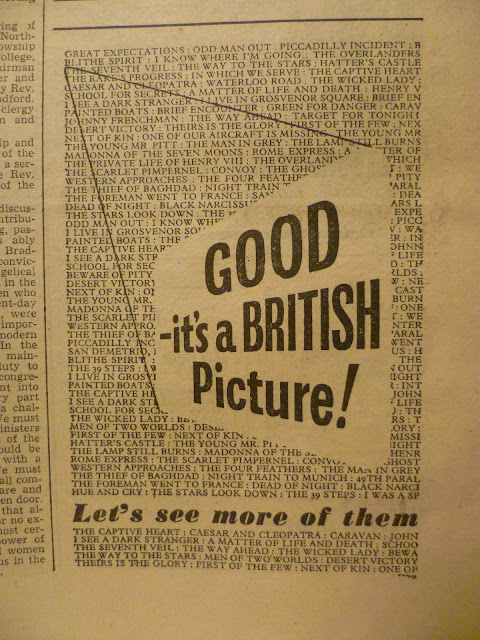 The Church of England Newspaper, 30 May 1947, 9.
Plus ça change, as we rootless cosmopolitans say.
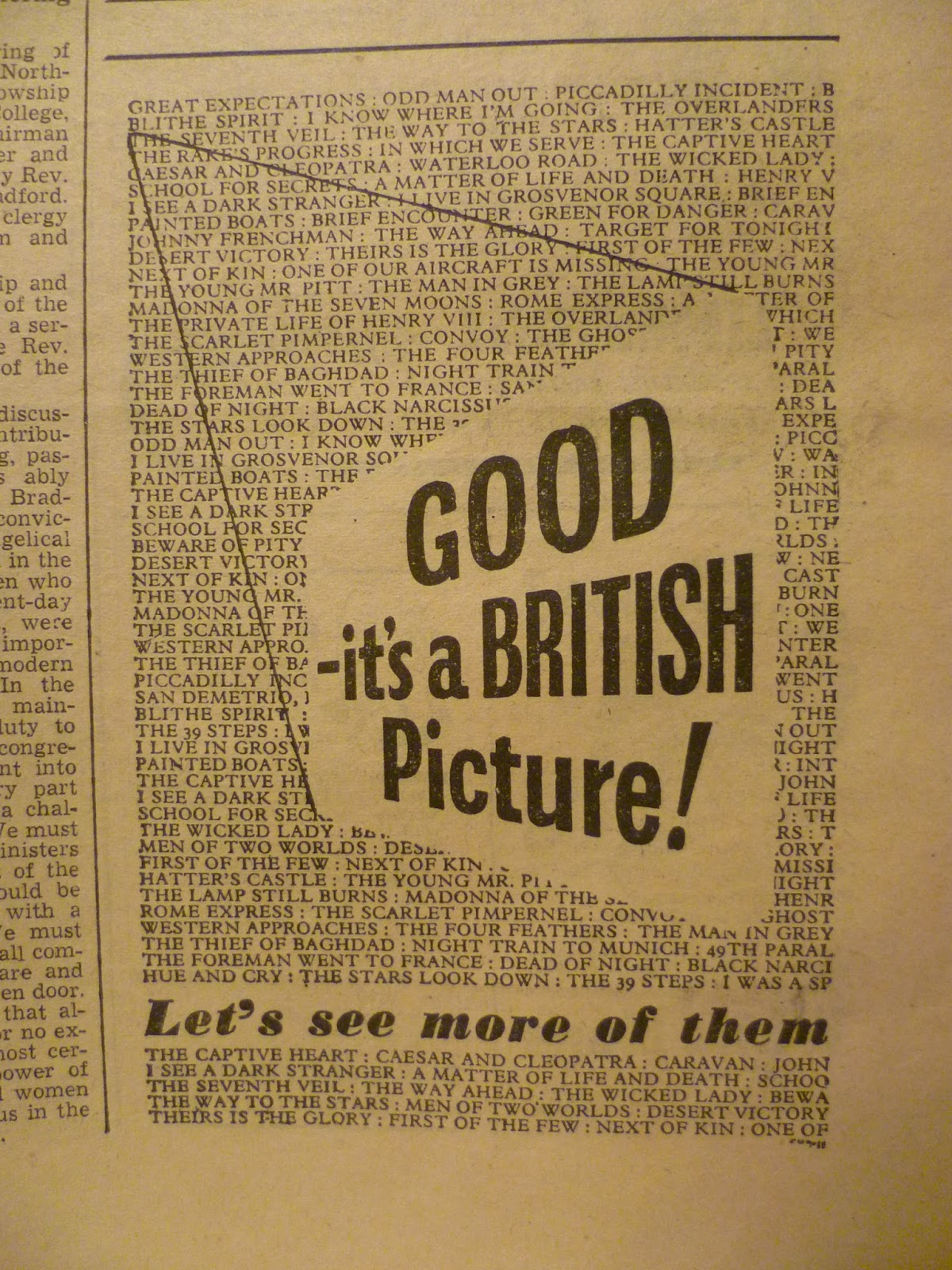
Wednesday, October 05, 2016
Meet you at the Big Ben Cloverleaf Interchange
A lucky escape there, London, I'd say.

The News Chronicle, 17 February 1941, 4

Monday, October 03, 2016
Mr Hobbes: Nipping infernos in the bud
“‘Mr Hobbes, the Atheist,’ the perpetrator of The Leviathan, like most people who insist on thinking straight, is usually classed as saying the opposite of what he meant.
He wanted peace. He wanted to call his soul his own, and to leave other men to do the same. He understood the conditions which, in this imperfect world, alone make liberty possible. He worked out the technique of defending it against three of its chief enemies, the champions of divine right, the champions of social and political privilege, and the fanatics of conscience.
He had no use for mass-murder or for suicide or for the doctrines which hallow them. He shared with St. Augustine, with Shakespeare (when he was being serious) and with Confucius the notion that there are no good and no bad men, but only men who often want, and sometimes manage, to behave better than they might.
He knew that one child with a stomach-ache in a nursery, one man in a bar with a grievance, one prig in an argument with a scruple, one girl at a picnic without one, can turn a game or a talk into a free fight, a social group into an inferno of suspicion, jealousy and hate. This was why he believed in having someone in the Chair at every social unit’s meeting who could be relied on to nip infernos in the bud.”
"Civilisation and War" (review by Kenneth Bell of Ranyard West, Conscience and Society) in The New Statesman and Society, 31 October 1942, 294. Paragraph breaks added.
Special Relationships, II: Black-and-white issues
When I was young, my mother told me all about how the dance halls in her village instituted "black nights" and "white nights" during the war as a result of intra-American conflicts and fights breaking out when some white soldiers saw black men dancing with local white women.
I was reminded of that when reading this:
"A London Diary", The New Statesman and Nation, 22 August 1942, 121. (Paragraph breaks have been added.)
I was reminded of that when reading this:
"Examples are beginning to reach me of the complications that are almost certain to arise if considerable numbers of coloured troops arrived with the American army. For instance, a British soldier writes to complain that in an English port part of a well-known restaurant is barred to coloured troops. He says that the employees of the restaurant disliked discriminating against coloured soldiers, and that a group of British soldiers near said what they thought about colour prejudice. He adds that his unit was called together and instructed to be ‘polite to coloured troops, answer their queries and drift away.’ They were not to eat or drink with coloured soldiers.
Before going off the deep end about this we must try to understand the nature of the problem that confronts the authorities, British and American. English people will find that coloured troops are particularly easy and pleasant to get on with, and I should think they should be extremely popular in most villages. American troops from a large part of the U.S.A. would agree with this, and be prepared to rub shoulders with the negro soldiers.
But the feeling of white troops from the ‘deep South,’ where the poison of slavery has never left the land, is something far too deep to brush aside. I have met Southerners who seemed rational enough until the negro problem was mentioned, and who would then suddenly show a terrified, lynching spirit which was about the ugliest thing imaginable.
The colour problem in the South is economic, political and sexual. The political side has been increased lately because the parties have begun to canvass for the negro vote. The economic aspect has increased with the increased opportunities of war-time employment. The social and sexual prejudice is so deep that there will be many Southern whites in this country who will take it for granted that it is their duty to interfere if they see black troops with white girls.
What is to be done? The American Government must itself face the problem. It must use every device of persuasion and authority to let white Southern troops know that it is against discipline to treat negro soldiers in the way to which their training and education has accustomed them. I am aware that with a prejudice as deep as that of the South, discipline and re-education will not work nearly quickly enough. I feel it is a mistake to send large numbers of coloured troops.
If things are left to drift an impossible problem will be set to the British authorities, and very unhappy incidents will occur between black and Southern troops, and, only too naturally, between Southern troops and the British, who will instinctively take the side of the blacks against their white assailants."
"A London Diary", The New Statesman and Nation, 22 August 1942, 121. (Paragraph breaks have been added.)
Special relationships, I: Swinging a line and sweet FA
Spotted in the New Statesman and Nation from many, many summers ago:
"The arrival of Americans makes us feel that something is really happening. I believe that for the most part the two armies are settling down well together, but inevitably there will be some friction. Old soldiers, who recall how the Americans came over last time, fresh when we had had three years of fighting and said they had won the war—they are just the men who are putting things right between the British and American troops. Both British and American have had wise advice given to them to prevent friction.Now: To the extent that Britons were ever more restrained than Americans when it comes to either self-regard or alcohol -- which may well have once been the case -- this seems like a long lost marker of cultural difference.
Difficulties are bound to arise because the Americans have far more money than the British, who are more sore about the allowances given to their wives than about anything else anyway. Also they are warned that Americans are apt to ‘swing a line’ while the British always understate.
An American recruit, naively pleased with his equipment, starts boosting his gas-mask. The English, smiling to themselves, egg him on a bit. The remark they would naturally make about their own mask is quite insincere, but traditional. They would curse the authorities for making them carry the thing at all, and add that anyway it would probably stop sweet Fanny Adams if came to the test."
"A Country Diary", The New Statesman and Nation, 25 July 1942, 58.
"I referred last week to the problem of Anglo-American relations in the village pub. My own observations this week have been that things are settling down very well, though the American habit of expecting whisky, which is not to be found because it has almost all been sent to America, has occasioned some ironic comment. It is just as well, in my view, that the whisky is not there, for the last two generations of Americans tend to treat alcohol too little as a social amenity and too much as an occupation."
"A London Diary", The New Statesman and Nation, 1 August, 1942, 72.
Friday, September 16, 2016
The middle class: "this patient ass"
In February 1942, the Dean of St. Paul's Cathedral, Rev. William Inge -- nicknamed "the gloomy Dean" -- stressed both the depth of the contemporary European crisis (which was not so unusual at that time) and advocated a resurgence in new forms of monasticsm as one part of a response to it (which was rather more original).
Interestingly, he here brought together his vision of a modern monastic revivial with some fulsome words for the middle classes.
I'm far from d'accord with a lot of Dean Inge's views (he was an ardent advocate of eugenics and, before the war, rather too sympathetic to the right-wing variants of totalitarianism); still, I find myself with advancing years -- much to my own surprise -- having a soft spot for kind words about "bourgeois liberalism" (or at least its "higher interests").
And a "refuge" from "anarchy and barbarism": oh yes, I'll have one of those please. Preferably with an ocean view, if possible.
Rev. W.R. Inge, "Community Life After the War", The Church of England Newspaper, 6 February 1942, 1.
“The suicide of European civilisation—we cannot use any milder phrase—makes it necessary to consider whether any plan can be devised to do for us, under modern conditions, what the monasteries did in the Dark Ages, that is to say, to provide a refuge for the gentler spirits, from the welter of anarchy and barbarism, and to save what could be saved of the cultural tradition of the shattered Empire.”
Interestingly, he here brought together his vision of a modern monastic revivial with some fulsome words for the middle classes.
“But on public grounds the most serious danger [to society as a result of the war] will be the virtual extinction of the highly educated and financially comfortable middle class, to which the greater part of our progress in all the arts of civilised life has been due. Now that the inverted snobbery of Bloomsbury and the brutal militarism of the Nazis unite in pouring scorn on ‘bourgeois liberalism,’ a member of the abused class may be forgiven for quoting the words of Euripides: ‘Of the three classes it is the middle which saves the country’. This patient ass, bowed between two burdens, must find some way of escape from a state of society which might make it impossible for him to devote himself to his higher interests.”
I'm far from d'accord with a lot of Dean Inge's views (he was an ardent advocate of eugenics and, before the war, rather too sympathetic to the right-wing variants of totalitarianism); still, I find myself with advancing years -- much to my own surprise -- having a soft spot for kind words about "bourgeois liberalism" (or at least its "higher interests").
And a "refuge" from "anarchy and barbarism": oh yes, I'll have one of those please. Preferably with an ocean view, if possible.
Rev. W.R. Inge, "Community Life After the War", The Church of England Newspaper, 6 February 1942, 1.
Friday, September 09, 2016
Stirring metaphors, lightly shaken
From the dark days of June 1940, a rather surprising -- and as far as I know, unique -- use of imagery:
The Church Times (21.6.1940), quoted in the Ministry of Information's weekly bulletin The Spiritual Issues of the War, no. 34, 22 June 1940, 2. (Emphasis and line breaks added.)
The entire task of upholding civilisation and the justice based on Christian faith has now fallen on the British Commonwealth of Nations, with such aid as may be extended by the friendly offices of the United States.
God has bestowed on the inhabitants of this Island certain advantages which make their position radically different from that of the Continental nations who have succumbed before the inhuman tide of brute force.
Those advantages devoted and consecrated to the Author and Giver Who has conferred them, are fully adequate to save Britain from the horn of the Nazi unicorn, and thereby to save European civilisation from being irremediably submerged.
The Church Times (21.6.1940), quoted in the Ministry of Information's weekly bulletin The Spiritual Issues of the War, no. 34, 22 June 1940, 2. (Emphasis and line breaks added.)
Wednesday, August 24, 2016
Of pansies, potatoes, and middle-aged sublimity
Amidst a much longer rumination on ageing by Frank W. Boreham, a popular early twentieth-century English Baptist preacher, one finds...a garden.
It carries on in this vein for some time and then draws some conclusions from George Eliot’s The Mill on the Floss and some thoughts about Habakkuk.
Then:
Dr. F. W. Boreham, "On Being Forty", The Christian World, 13 June 1940, 8. (Line-breaks added)
A man’s life is like a garden. There is a limit to the things that it will grow. You cannot pack plants in a garden as you pack sardines in a tin. That is why the farmer thins out the turnips, the orchardist prunes his trees, and the husbandman pinches the grapebuds off the trailing vines.
Life has to be treated similarly. By the time a man enters middle life he realizes that his garden is getting overcrowded. It contains all the flowers that he planted in his sentimental youth and all the vegetables that he set there in his prosaic manhood. It is too much.
There must be a thinning out. And, unless he is extremely careful, he will find that the thinning-out process, will automatically consist of the sacrifice of all the pansies and the retentions of all the potatoes.
It carries on in this vein for some time and then draws some conclusions from George Eliot’s The Mill on the Floss and some thoughts about Habakkuk.
Then:
The man of forty rests, therefore, under at least three imperative obligations. He must make up his mind that the arrival of middle-age has not closed against him the door of enterprise; he must resolve that, in the mature years of his life, he will cherish some of the more amiable sentiments that inspired his impressionable youth; and he must regard himself as the natural protector of those who are battling fiercely and bravely with the forces through which, not without scars, he has himself passed.Articles "On Being Fifty" and "On Being Sixty" followed, so Dr. Boreham seems to have been speaking with some experience.
In spite of everything, middle-age may then be made sublime.
Dr. F. W. Boreham, "On Being Forty", The Christian World, 13 June 1940, 8. (Line-breaks added)
The past: perhaps a not-so-foreign country
This feels familiar:
"Sparrows thinking aloud" is a very, very nice turn of phrase.
"Ludgate", "The World Goes By", The Christian World, 13 June 1940, 2. (Line breaks added.)
Never before, I suppose, has so much music rolled into our lives as now. I have sometimes thought it would be an ideal thing if a river ran past at the foot of everybody’s garden. That is impossible. But now, with the coming of wireless, everybody may regard his home as being built on the banks of music. We ought never to shut out, however, and never forget, the pleasantness of natural sounds.
It is when somebody has had the wireless going too long, and it is at last mercifully shut off, that we rediscover the charm of the little friendly sounds in and about home—a clock, or the lapping of flames in the firegrate, in winter, or the sparrows thinking aloud or the leaves of trees in a light breeze in summer.
Dr. J.H. Jowett, on a boat up the Thames complained of the people who brought gramophones with them. With the gramophone they cut out much pleasanter and, in that setting, more suitable sounds—the water curling along the side of the boat, the rushes in the bank, talking under their breath.
One day this week I was standing in the garden of some friends of mine; such a garden! Lupins of all shades, like scores of pinnacles above a city, roses healthy and regal, fruit trees with heavy branches of growing fruit—all moist, full, and fresh.
But when I was there half the garden’s soul was cancelled out. The son of a neighbour, in his teens, had all windows open and was rehearsing his jazz band. La, la, clip, clop, la-di-da, clapperti-klonk. Whatever it sounded like where everything else was artificial, it was a tin-lid-and-dustbin horror there.
The best music made by human beings is wonderful. I love an orchestra. But I love the sound of rain.
"Sparrows thinking aloud" is a very, very nice turn of phrase.
"Ludgate", "The World Goes By", The Christian World, 13 June 1940, 2. (Line breaks added.)
Subscribe to:
Posts (Atom)